Brandon's Take
What Actually Happens When a Small Business Gets Hacked
Small businesses are the primary target of cyberattacks, not an afterthought — 43% of all cyberattacks are aimed at small…
Read →

 brandon sheriff··5 min read·52 views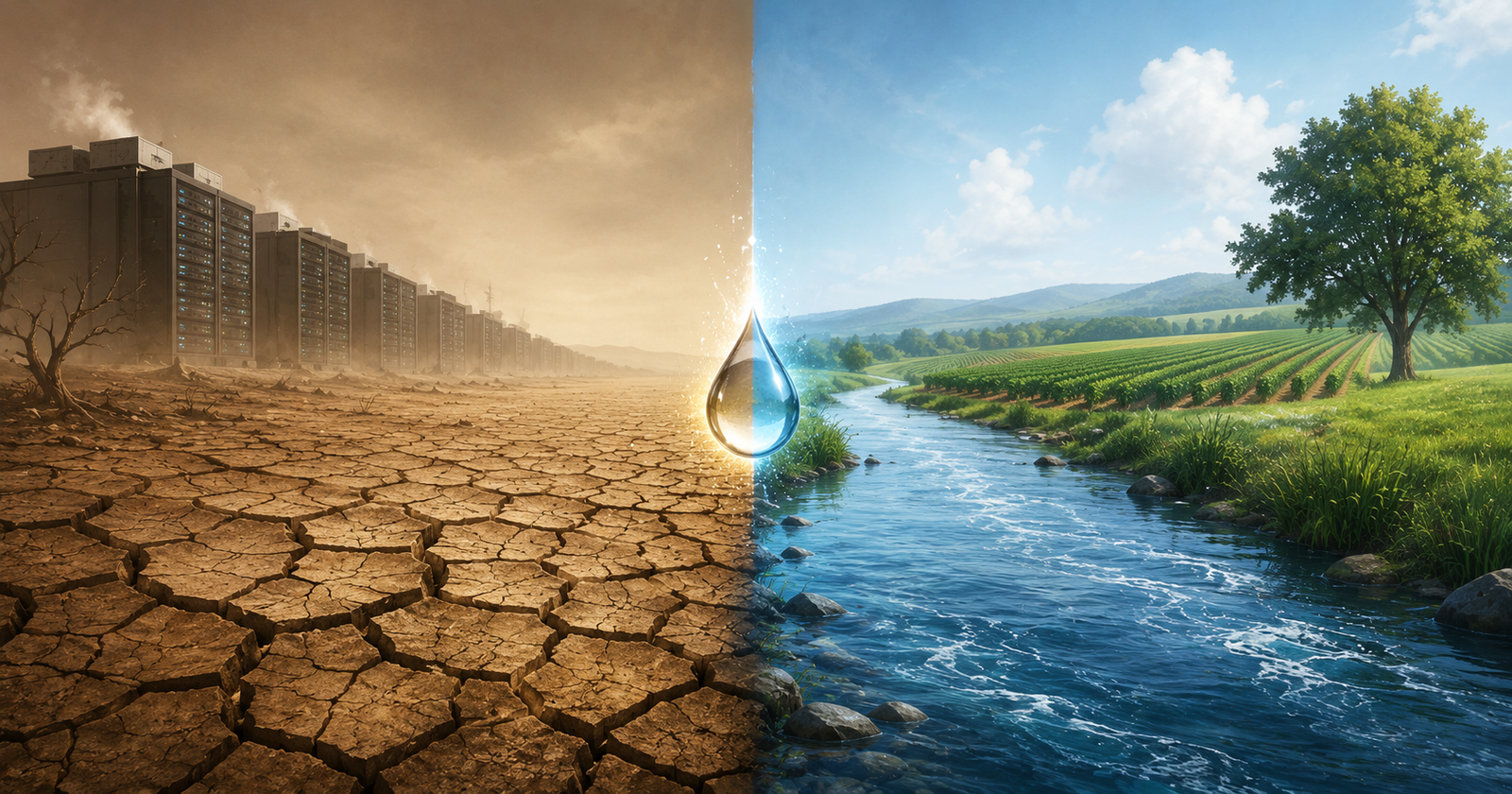
I was in Arizona not long ago, and it got me thinking about water in a way I hadn’t before.
Arizona has a well-documented water shortage. The Colorado River — which supplies water to tens of millions of people across the Southwest — no longer consistently reaches the sea. Lake Mead hit historically low levels in recent years. The state has been in various stages of water management crisis for a while now. None of that was new information to me.
What struck me was what’s being built there anyway. Data centers. Lots of them. Arizona is now the fourth-largest data center market in the country, and the Phoenix metro alone is on pace for massive growth in AI infrastructure. Data centers need cooling. Cooling — especially evaporative cooling — uses water. A lot of it. And in a state already importing water from other states to meet basic needs, that’s a tension worth paying attention to.
To be fair, the picture is more complicated than “data centers are draining Arizona dry.” Some projections have been overstated, and several large operators have moved toward closed-loop cooling systems that significantly reduce water consumption. Microsoft has committed to zero-water cooling across its owned portfolio. But the directional concern is real: projections show Phoenix-area data center water use potentially growing tenfold as AI infrastructure expands. And the Colorado River basin already holds only about 36% of its total storage capacity.
That got me researching. And then it got personal.
I live in Iowa
Iowa is not a place most people associate with water stress. We have rivers. We have rainfall. Farming here has historically operated with almost no irrigation restrictions — water felt abundant.
Turns out, abundant isn’t the same as clean. Or safe. Or sustainable.
Over the summer of 2025, nitrate levels in the Des Moines and Raccoon Rivers — the primary drinking water sources for over 500,000 people in central Iowa — surged to dangerous levels. The Des Moines nitrate removal facility, one of the largest in the world, ran for 112 days straight trying to keep up. It restarted again in January 2026, the first mid-winter operation since 2015. Researchers are now calling persistently elevated winter nitrates “the new normal.”
About 80–92% of the nitrogen polluting those rivers comes from agricultural runoff — fertilizers and livestock operations feeding Iowa’s massive farm economy. Nitrates at high levels are linked to birth defects, thyroid disorders, and cancer. Iowa currently has the second-highest cancer rate in the nation, and it’s one of only two states where cancer rates are still rising. Researchers are actively examining the link to long-term nitrate exposure. The World Health Organization classifies nitrate in drinking water as “probably carcinogenic.”
I knew about the high nitrate levels in Iowa water. What I didn’t fully appreciate until I started digging was how acute the situation has become — and how much it intersects with policy failures. The EPA under the current administration actually reversed its listing of several Iowa waterways as impaired, removing them from the protected status they’d been granted, without scientific justification. Environmental groups filed suit in May 2026.
So here we are: a state with abundant water resources, some of the most productive farmland in the world, the infrastructure to filter millions of gallons a day — and still struggling to provide reliably safe drinking water to its residents.
The bigger picture
Fresh water is one of those things that gets quietly filed under “infrastructure problem” or “environmental issue” until it isn’t anymore. Most people treat it as a given. Turn on the tap. Water comes out. Move on.
But the global math has always been tighter than that framing suggests. About 71% of the Earth’s surface is covered in water. Less than 3% of it is fresh. Of that, roughly two-thirds is locked in glaciers. What remains — the liquid fresh water that human civilization actually runs on — is a fraction of a fraction of what we see when we look at a map.
And it’s not distributed evenly. Some regions have more than they could ever use. Others are already operating beyond sustainable limits. The places with the most acute stress — parts of the Middle East, South Asia, sub-Saharan Africa, the American Southwest — are often also places dealing with agricultural pressure, population growth, or industrial demand that only makes the math harder.
The data center angle is a new version of an old tension: economic activity competing with basic human needs for the same finite resource. What makes it interesting is that data centers are increasingly located in water-stressed regions precisely because land is cheap and regulations are favorable there. The AI boom hasn’t created this conflict, but it’s accelerating it.
Israel figured out a version of this problem — not by wishing water into existence, but by investing seriously in desalination, wastewater recycling, and agricultural efficiency over decades. They now recycle about 90% of their wastewater, the highest rate in the world, and have effectively engineered themselves out of water stress. It’s a genuinely impressive story of what’s possible with sustained commitment. Whether it’s replicable elsewhere depends heavily on political will and investment capacity that most water-stressed regions don’t currently have.
What I think about differently now
Water used to feel renewable to me in the way air feels renewable — always replenished, always available, the kind of resource you don’t have to think about.
That’s not quite right. Water is finite in the places and timeframes that matter to actual human beings. Aquifers that took thousands of years to fill can be drawn down in decades. Rivers can shrink. Reservoirs can empty. And even where water is physically present, contamination can make it unusable for drinking, for farming, for the industrial uses we’ve quietly built entire economies around.
The places that will handle this well are the ones that stop treating water as a background assumption and start treating it as what it actually is: a finite, geography-dependent, increasingly contested resource that requires real planning and real investment to manage responsibly.
Iowa has the water. The question is whether we’ll take the contamination problem seriously enough to fix it — or keep deferring it while the cancer rates climb.
That’s the question I think about now when I turn on the tap.
Explore Intelligent Analytics → [/]

Small businesses are the primary target of cyberattacks, not an afterthought — 43% of all cyberattacks are aimed at small…
Read →Research mining more than 20,000 real strategic plans found that 84.5% of strategic projects never actually reach completion — only…
Read →I'll be honest about something upfront: I'm not an economist, and this isn't my area of deep expertise. But I've…
Read →