Brandon's Take
The Four-Day Workweek Trials: What the Evidence Actually Shows
Four-day workweek trials covered thousands of employees. See what the research found, what it cannot tell a small business, and…
Read →

 brandon sheriff··6 min read·10 views
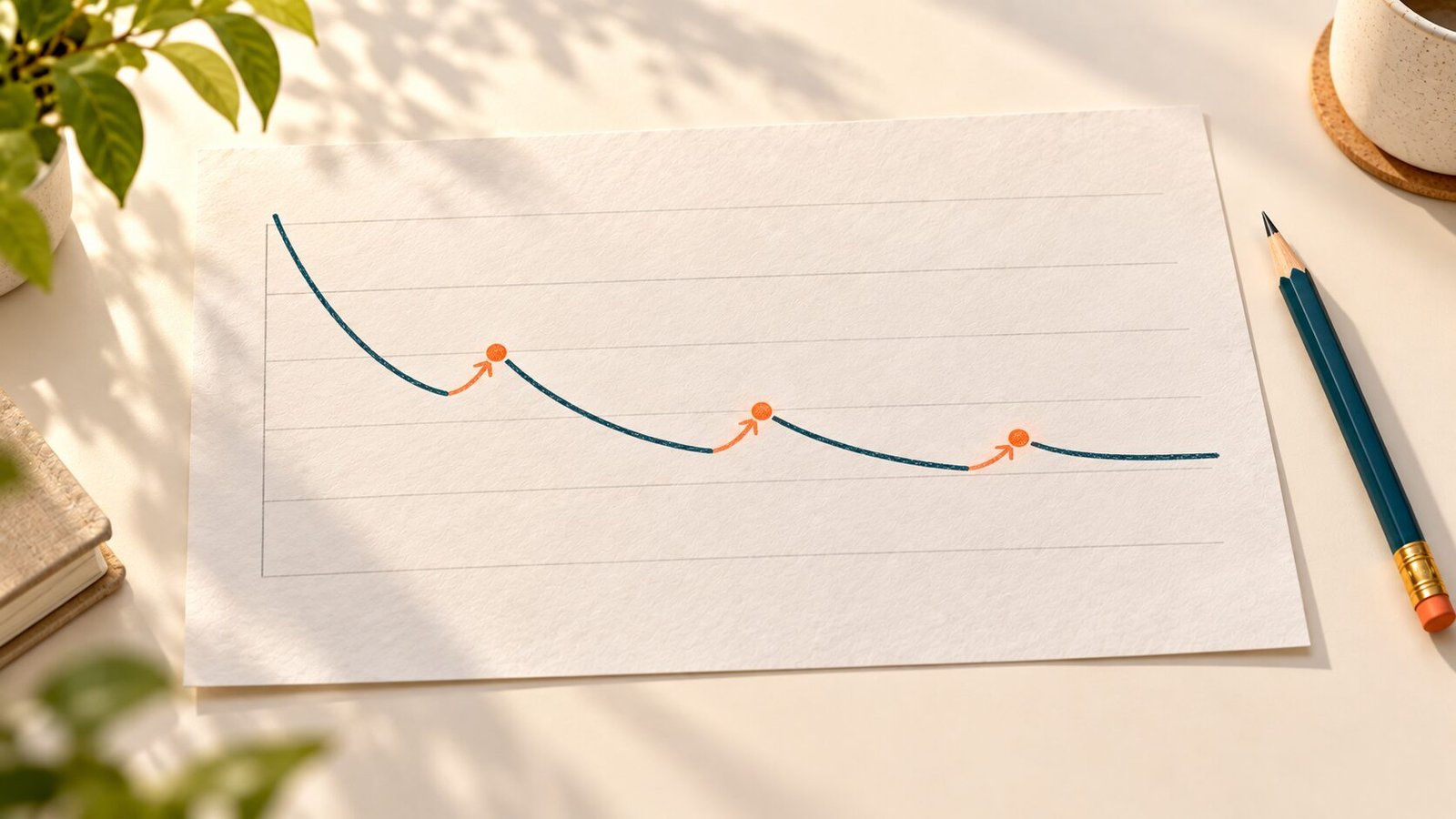
In the 1880s, a German psychologist named Hermann Ebbinghaus memorized lists of nonsense syllables and tested himself to see how quickly he forgot them. The pattern he found was steep: most of what he lost, he lost early. In 2015, researchers in the Netherlands repeated the experiment with a single volunteer, who spent about 70 hours on 70 lists using Ebbinghaus’s original schedule. The curve held up.
That was one participant, so it’s a small replication. But more than a century of larger studies point the same way. We forget fast, and when you practice makes a big difference to how much sticks.
Spaced practice, also called distributed practice, means spreading your learning over several sessions with gaps in between. Cramming is the opposite. Researchers call it massed practice.
You can study the same total amount either way. What changes is the timing.
The big review. A 2006 meta-analysis in Psychological Bulletin by Nicholas Cepeda and colleagues pulled together 839 assessments from 317 experiments in 184 articles. Spacing study sessions out improved recall compared with massed study. They also found the best gap depends on how long you want to remember the material: the longer the memory you want, the longer the best gap.
How long a gap? A follow-up study by Cepeda and colleagues in 2008 tested more than 1,350 people. A university summary of the results puts the best gap at roughly 5 to 20 percent of the time you need to remember something. For a test three weeks away, that meant reviewing several days after first learning the material. For something you want to remember for a year, it meant reviewing at least a month later. These are guides, not formulas.
How spacing compares with other methods. In 2013, John Dunlosky and four colleagues published a review in Psychological Science in the Public Interest that rated ten common learning techniques. Practice testing and distributed practice earned the highest utility ratings. Summarizing, highlighting, underlining and rereading earned low ones.
Why we don’t do it. In a 2008 study in Psychological Science, Nate Kornell and Robert Bjork had students learn to identify painters from sample paintings, either grouped by artist (massed) or mixed together (spaced). Across the experiments, about 85% of participants did at least as well with spacing, yet in the first experiment 78% said massing was as good as or better. Spacing feels harder, and we tend to read that feeling as a sign it isn’t working. Bjork calls this kind of effort a “desirable difficulty.”
In a real classroom. Harvard’s B. Price Kerfoot ran a randomized trial with more than 500 urology residents in the US and Canada. One group got all of the study questions at once. The other got one or two questions by email each day, repeated at intervals over 27 weeks. The spaced group scored significantly higher on later tests of that material. The trial did not show an improvement on the residents’ actual in-service exam, so I wouldn’t oversell it.
Music is one of the most common places people practice, so you’d expect clear answers here. The research is more mixed.
Sarah Allen, a music education researcher at Southern Methodist University, studied 60 music majors practicing melodies on a digital piano. Players who practiced one melody improved the next day after a night of sleep. When they practiced two similar melodies back to back, the overnight gains for the first one shrank, and replaying the first melody before bed counteracted that. It’s a press-release summary of her work, and she says more research is needed.
A 2017 study in PLoS ONE by Wiseheart and colleagues, with 100 university students who were almost all piano novices, tested gaps of 0 to 15 minutes between practice sessions on a 17-note sequence. They found no spacing effect. The authors suggest the effect may not always show up for complex motor skills, and that very little forgetting happened in such short gaps.
So the honest summary is that spacing is well established for facts and words, and less settled for physical skills like playing an instrument. Most of the studies use students, short tasks and short gaps.
I definitely used spaced practice with music, long before I knew it had a name. When I’m learning something musically, I get diminishing returns from sitting for a long stretch and working the same piece over and over. Sometimes a 30-minute or hour-long break is enough. I come back and start the new session in better shape than I was at the end of the last one. Other times I don’t leave the instrument at all. I play through songs I’ve already learned, then go back to the piece I’m working on, and that resets my brain and refocuses me just as well.
Cramming has never worked for me, and I’ve known that for a long time. Studying for tests and pushing through long hours never stuck. I lose focus, I catch myself rereading the same thing I just read, and not much goes in. According to Dunlosky’s review, rereading is one of the techniques rated lowest, which makes me feel a little better about that.
What does work is small sessions over days or weeks. I’ll spend 30 to 45 minutes on a topic, then come back the next day or a couple of days later. I go over what I learned last time, then apply it and work on getting better at it. Reviewing and then using it, instead of just rereading, is probably doing more of the work than I realized. Practice testing earned the other top rating in that review.
I found the music research interesting, because it didn’t give a neat answer. The Allen study fits what I’ve felt about breaks and about going back to songs I already know, but it’s about sleep and interference, which isn’t the same thing. And the piano study that found no spacing effect used novices and gaps of 15 minutes or less, which is far shorter than my breaks. I don’t think that contradicts what I’ve noticed. It just tells me that this is still being figured out.
Either way, I’d rather learn in short sessions than force long ones, and I’d rather trust a method that feels a bit slower and works than one that feels productive and doesn’t.
It’s spreading your learning across several sessions with time between them, instead of covering everything in one sitting. The research shows it improves how much people remember, even when the total study time is the same.
It depends on how long you want to remember what you’re learning. In a 2008 study of more than 1,350 people, the best gap was roughly 5 to 20 percent of the time you need to remember the material, so a test in three weeks calls for a review several days in, and a memory for a year calls for a review at least a month later. Treat that as a starting point and adjust to how you learn.
For something you only need for a short time, it can get you through, though the Ebbinghaus curve shows how quickly the material fades afterward. The research on spacing suggests the longer you need to remember something, the less cramming helps.
The evidence is less settled. One study found players who practiced a melody improved overnight after sleep, and another found no spacing effect for novices learning a short piano sequence with gaps up to 15 minutes. More research is needed on how this applies to instruments and sports.

Four-day workweek trials covered thousands of employees. See what the research found, what it cannot tell a small business, and…
Read →Quantum computing works fundamentally differently than the computer in your pocket — using qubits instead of simple on-off switches, able…
Read →Small businesses are the primary target of cyberattacks, not an afterthought — 43% of all cyberattacks are aimed at small…
Read →